
ABOUT N. JAY JAFFEE
Photographs are born of the positives and negatives accumulated in a lifetime.
– N. Jay Jaffee
Biography
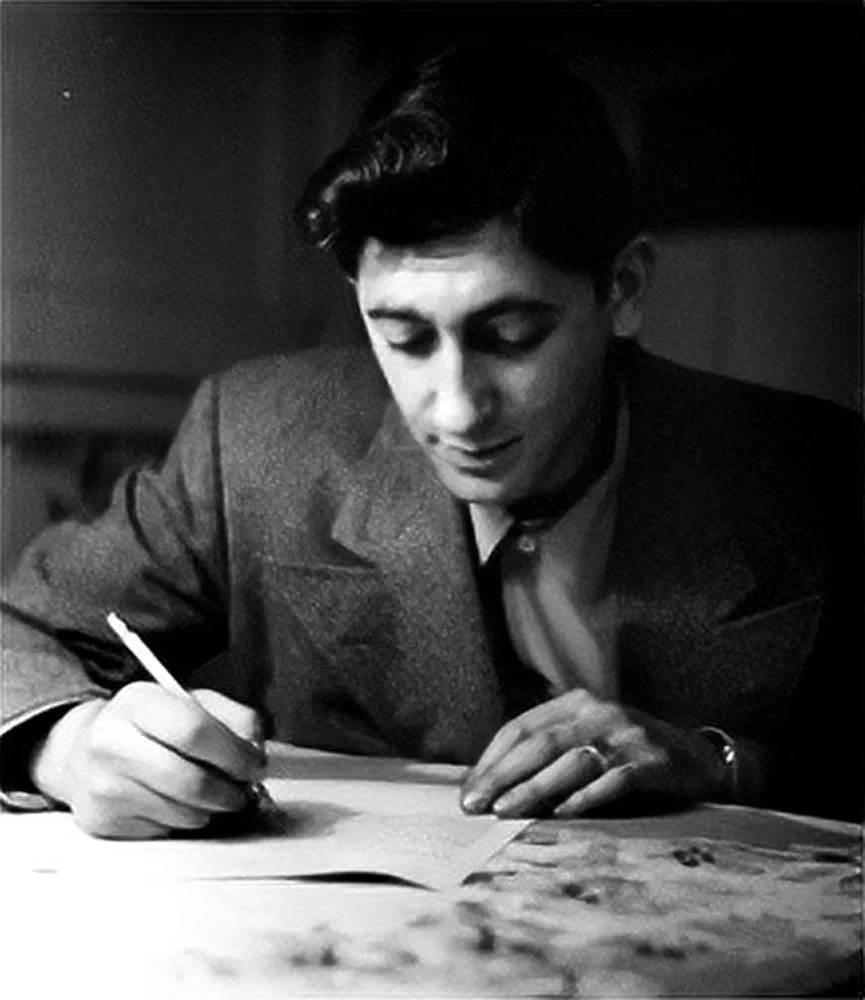
The third child of Isidore and Anna Jaffee, Nathan Jaffee (later N. Jay Jaffee) was raised in various Brooklyn neighborhoods, from Brownsville to Crown Heights to East New York.Jaffee attended trade school briefly, leaving early to work as a typesetter. His commitment to social justice began with union organizing at a young age. Jaffee soon became active in Local 65, a trade union known for its progressive politics.
In 1947, fresh out of the army, recently married, and struggling to reconcile his traumatic experiences of war with the society to which he returned, Jaffee picked up his camera. He had been an infantry squad leader during World War II and had seen heavy combat in Europe. Initially photographing was a catharsis, a means of affirming life in contrast to the irrational destruction of war. By rejoicing in and recording the humor and warmth of the social community—people in pursuit of their daily lives—he hoped to reconnect to civilian life and restore his sense of humanity.
Jaffee started photographing the Brooklyn neighborhoods in which he grew up. The rest of New York City also beckoned. His work captured the movements and shadows of the city streets, subways, signs, markets, and the people who inhabited them.
Jaffee’s formal training came after he had been photographing for some time. He attended classes taught by Sid Grossman, of the legendary New York Photo League, and other classes at the League. When he met with Edward Steichen, then curator of photography at the Museum of Modern Art (MOMA), Steichen offered encouragement and requested three prints. These later became part of the museum’s permanent collection. In 1950, two of the prints were included in the seminal group show at MOMA, “Fifty-One American Photographers.”
While raising a family—he had two daughters, Anna and Cyrisse, with his wife Isabel—and working in the printing industry, Jaffee continued to photograph in the classic black-and-white format throughout the 1970s and 1980s. He remained active in progressive movements, documenting political demonstrations, rallies, and concerts.
Jaffee eventually moved to Huntington, Long Island. Although he had always photographed nature, his later work included more landscapes and seascapes, locally and across the country. His travels brought the opportunity to photograph Europe and Canada.
After being represented by the famous Howard Greenberg Gallery in New York, he joined the Sarah Morthland Gallery, also in New York. Just before his death in 1999, he established The N. Jay Jaffee Trust, an archive which now holds his complete works, including prints, negatives, equipment, and related materials.
For more than half a century, the camera served as an instrument through which Jaffee interpreted the world and his place in it. “Photographs,” he once wrote, “are born of the positives and negatives accumulated in a lifetime.”
Note: This biography was adapted from the exhibition catalog Coney Island to Caumsett: The Photographic Journey of N. Jay Jaffee: 1947–1997, by Janie Welker, Heckscher Museum, 1999.
Career Highlights
A major one-person show, “Inward Image,” was shown at the Brooklyn Museum in 1981. In September 1999, a 50-year retrospective, “Coney Island to Camusett: The Photographic Journey of N. Jay Jaffee: 1947–1999,” organized before his death in March of that year, was shown at the Heckscher Museum of Art in Huntington, New York.
Several shows about The Photo League, such as “The Radical Camera: New York’s Photo League 1936–1951,” in 2011, included his work. Many other group shows have featured his photographs, such as Breaking the Mold: Brooklyn Museum at 200” in 2025, and “Touchstones of the Twentieth Century: History of Photography” in 2021. (For more information, see Exhibits & More.)
Jaffee’s work is in the collections of many major museums, universities, and libraries, including: Museum of Modern Art, Metropolitan Museum of Art, Smithsonian Museums (National Portrait Gallery, National Museum of American Art), Brooklyn Museum, George Eastman Museum, Museum of Fine Arts Boston, Harvard Art Museums, Library of Congress , New York Public Library, Center for Brooklyn History, and the Bibliothéque Nationale de France. (For more information, see Collections.)
College courses or projects based on N. Jay Jaffee’s life and work have been offered at Yale University, Skidmore College, and SUNY Binghamton.
Publications
Books
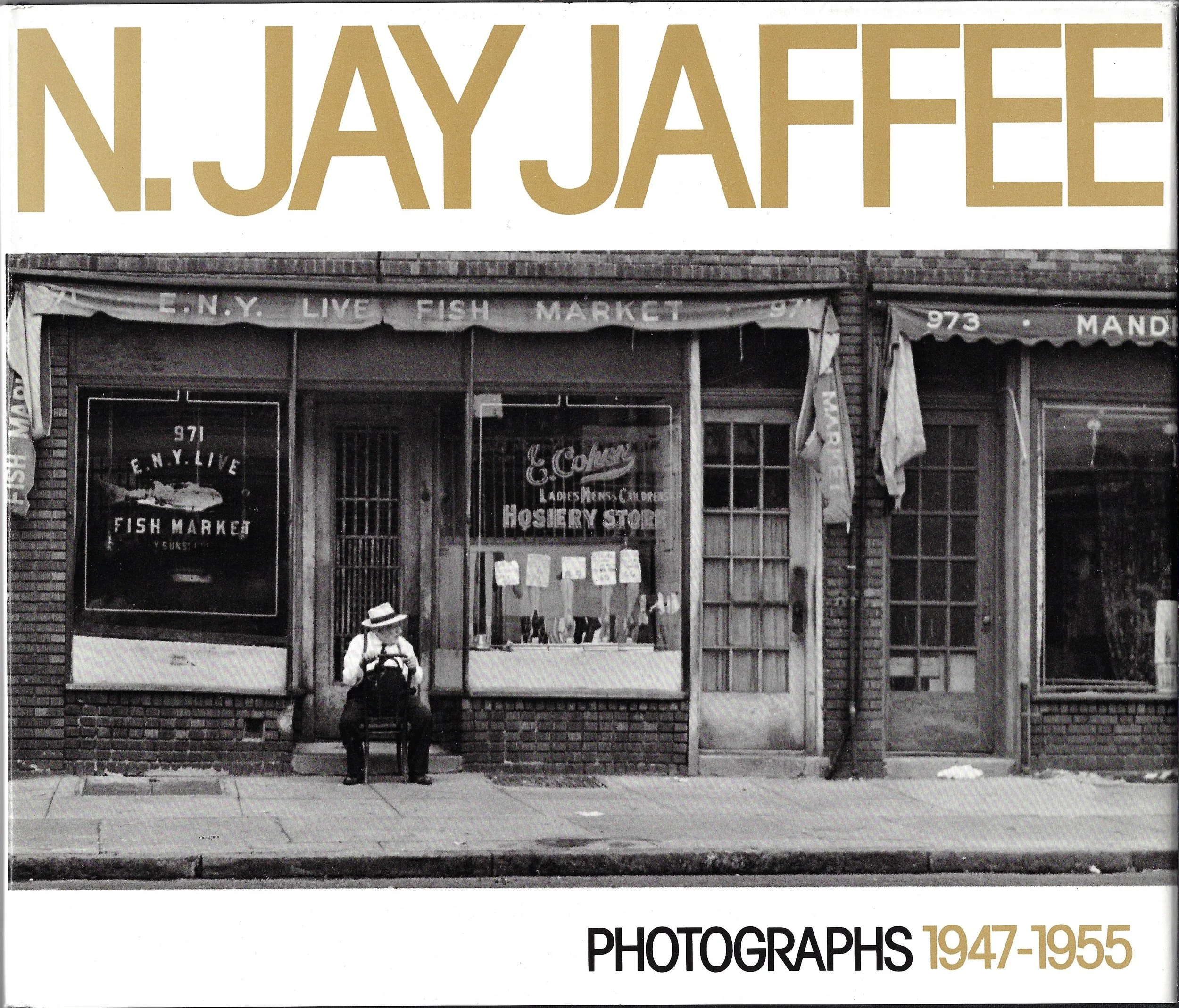
A book of his photographs, N. Jay Jaffee: Photographs 1947–1956, was published by Henley Graphics in 1976.
His work has also been included in many books on photography, history, and New York, including:
American Century of Photography: From Dry-Plate to Digital, edited by Keith David, Cityscapes: A History of New York in Images by Howard B. Rock and Deborah Dash Moore, This Was the Photo League: Compassion and the Camera from the Depression to the Cold War by Anne Wilkes Tucker, Claire Cass, and Stephen Daiter, and Walkers in the City: Jewish Street Photographers of Mid-Century New York by Deborah Dash Moore. (For more titles, see Exhibits & More.)
Articles about N. Jay Jaffee (selected)
Harris, Helen. “Art Reviews,” The New York Times, October 10, 1999.
Wallace, George. “Photos: From Coney Island to Caumsett,” The Long Islander, August 19, 1999.
“N. Jay Jaffee, Photographer Who Captured City Life,” Obituary, Newsday, March 14, 1999.
Senf, Bret. “After 50 Years, Looking for Fresh Images,” The New York Times, December 22, 1996.
“Lloyd Harbor Photographer in Smithsonian.” The Long Islander, February 22, 1993.
Botkin, Joshua. “Photographer Uses Camera as Therapy,” The Long Islander, July 6, 1989.

Rayner, Vivian. “Two Shows of Images on Film,” The New York Times, January 27, 1985.